Turmeric
Turmeric is a plant in the ginger family, and oral turmeric is promoted as a dietary supplement for many conditions. NCCIH says we don't know enough to definitively conclude if turmeric or curcumin is beneficial for any health purposes. Initial evidence for osteoarthritis is positive, but higher-quality evidence is needed.
Turmeric, a plant in the ginger family, is grown commercially in Southeast Asia and India. Today, oral (taken by mouth) turmeric is promoted as a dietary supplement for a variety of conditions.
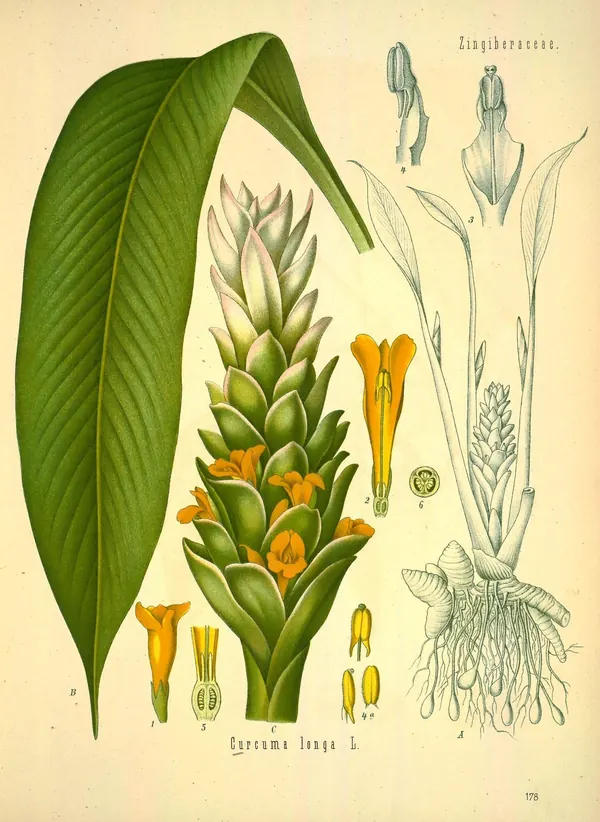
Köhler's Medizinal-Pflanzen (1890), public domain; scan: Biodiversity Heritage Library, via Wikimedia Commons
Where to get it
We earn a commission if you buy through these links. It doesn't change your price. How we make money
Traditional & historical use
Turmeric has been used in Ayurvedic and traditional Chinese medicine for thousands of years as a treatment for digestive complaints, skin conditions, and as an anti-inflammatory remedy. NCCIH notes it has a long history of use in cooking and as a medicine in Southeast Asia.
Active compounds & mechanisms
Key compounds: curcumin, curcuminoids, bisdemethoxycurcumin, demethoxycurcumin, turmerone (volatile oil)
Curcumin is the main bioactive curcuminoid in turmeric, though it makes up only about 2–5% of turmeric powder by weight. Curcumin inhibits NF-κB, a key regulator of the inflammatory response, and suppresses COX-2 enzyme activity — both pathways involved in chronic inflammation. Curcumin has very low bioavailability on its own; absorption is significantly increased by black pepper extract (piperine, ~20×) or by lipid-based or phospholipid formulations. Some antidepressant effects may come from modulating serotonin and dopamine pathways.
Research & evidence
Strong support Some support Weak or no supportColours show how well the sources back each point. The reason is next to each one.
NCCIH says we don't know enough to definitively conclude if turmeric or curcumin is beneficial for any health purposes. It also says there isn't enough evidence to definitively conclude whether oral turmeric or curcumin has beneficial effects for other conditions.
Limited evidenceSome support. Reviewers rated the certainty low
Study details
NCCIH (How Much Do We Know?): "We don’t know enough to definitively conclude if turmeric or curcumin is beneficial for any health purposes." | NCCIH (What Have We Learned?): "There isn’t enough evidence to definitively conclude whether oral turmeric or curcumin has beneficial effects"
Source: NCCIH, Turmeric (Last Updated April 2025), How Much Do We Know? View source
For osteoarthritis, NCCIH says the initial evidence for oral turmeric is positive, but higher-quality evidence is needed to reach definitive conclusions. It's unclear whether topical curcumin ointment has an effect on pain related to knee osteoarthritis.
Limited evidenceSome support. The source hedges (“may” or “associated with”)
Study details
NCCIH (What Have We Learned?): "The initial evidence is positive; higher-quality evidence is needed to reach definitive conclusions" | NCCIH (What Have We Learned?): "It’s unclear whether topical curcumin ointment has an effect on pain related to knee osteoarthritis."
Source: NCCIH, Turmeric (Last Updated April 2025), What Have We Learned? View source
NCCIH says initial research suggests that oral turmeric or curcumin might improve some NAFLD (non-alcoholic fatty liver disease) measures, but it's unclear which specific measures are consistently improved. MSK says a systematic review found that both turmeric and curcumin may benefit patients with non alcoholic fatty liver disease.
Limited evidenceSome support. The source hedges (“may” or “associated with”)
Study details
NCCIH (What Have We Learned?): "Initial research suggests that oral turmeric or curcumin might improve some NAFLD measures," | NCCIH (What Have We Learned?): "it’s unclear which specific measures are consistently improved." | MSK (Research Findings (Clinical Summary)): "A systematic review found that both turmeric and curcumin may benefit patients with non alcoholic fatty liver disease"
Source: NCCIH, Turmeric (Last Updated April 2025), What Have We Learned? View source
NCCIH says initial research suggests that turmeric or curcumin in an oral or mouthwash formulation might improve oral mucositis.
Limited evidenceSome support. The source hedges (“may” or “associated with”)
Study details
NCCIH (What Have We Learned?): "Initial research suggests that turmeric or curcumin in an oral or mouthwash formulation might improve"
Source: NCCIH, Turmeric (Last Updated April 2025), What Have We Learned? View source
MSK says clinical studies suggest benefits of turmeric for major depressive disorder.
Limited evidenceSome support. The source hedges (“may” or “associated with”)
Study details
MSK (Research Findings (Clinical Summary)): "Clinical studies suggest benefits of turmeric for major depressive disorder"
Source: MSK, Turmeric (Last Updated Tuesday, June 9, 2026), Research Findings (Clinical Summary) View source
MSK says there were no benefits of curcumin supplements in patients with Alzheimer's disease.
Not supported by current evidenceWeak or no support. Trials found no clear benefit
Study details
MSK (Research Findings (Clinical Summary)): "But there were no benefits of curcumin supplements in patients with Alzheimer’s disease"
Source: MSK, Turmeric (Last Updated Tuesday, June 9, 2026), Research Findings (Clinical Summary) View source
Dosage
| Form | Amount |
|---|---|
| Capsule | 500–2,000 mg of curcuminoids per day, typically as standardised turmeric extract (95% curcuminoids). Plain turmeric powder is poorly absorbed; choose a product with BioPerine (piperine) or a phospholipid/lipid formulation. |
| Powder | ½–1 tsp (≈ 1,500–3,000 mg) of turmeric powder per day in food or "golden milk". Note: cooking provides very low curcumin doses compared to standardised extracts. |
Side effects
Turmeric can cause nausea and vomiting, acid reflux and stomach upset. Highly bioavailable curcumin products may harm your liver, so stop and talk with your health care provider if you notice fatigue, nausea, poor appetite, dark urine or jaundice. Turmeric supplements may be unsafe in pregnancy and may raise your risk of kidney stones.
Well documented Reported (case reports, anecdotal or one study) None reportedThe circle shows how well documented an effect is, not how serious it is. A rarely reported effect can still be serious, so always read ‘When to stop’.
| Effect | Frequency | When to stop |
|---|---|---|
| Nausea and vomiting, acid reflux, stomach upset, gastrointestinal discomfortWell documentedListed plainly by NIH, MSK or LiverTox | Not stated | Stop and talk to a doctor if you notice any unexpected or concerning symptoms. |
| Liver damage, reported in some people who consumed highly bioavailable curcumin formulations; MSK also lists case reports linked to chronic consumption of turmeric (signs include fatigue, nausea, poor appetite, dark urine or jaundice)ReportedCase reports only | Not stated | Stop consuming turmeric or curcumin products immediately and talk with your health care provider. |
| May raise the risk of kidney stonesWell documentedListed plainly by NIH, MSK or LiverTox | Not stated | Stop and talk to a doctor if you notice any unexpected or concerning symptoms. |
| Contact urticaria (an allergic skin reaction), two case reports associated with curcumin powderReportedCase reports only | Not stated | Stop and talk to a doctor if you notice any unexpected or concerning symptoms. |
Safety & interactions
Safety
NCCIH says conventionally formulated oral turmeric or curcumin (not modified to enhance bioavailability) is likely safe in the recommended amounts for up to 2 or 3 months. Highly bioavailable formulations of curcumin, which enhance the body's ability to absorb the curcumin, may harm your liver, and liver damage has been reported in some people who have consumed these bioavailable formulations. If you notice liver damage symptoms such as fatigue, nausea, poor appetite, dark urine, or jaundice, stop consuming turmeric or curcumin products immediately and talk with your health care provider. Oral turmeric can cause adverse effects such as nausea and vomiting, acid reflux, stomach upset. MSK lists case reports of liver problems associated with chronic consumption of turmeric, including three cases of autoimmune hepatitis, and says that in all cases symptoms resolved with cessation of turmeric use.
Contraindications
NCCIH says the use of turmeric supplements during pregnancy may be unsafe. MSK says taking turmeric supplements may put you at a higher risk of getting kidney stones. MSK also lists two cases of contact urticaria (an allergic skin reaction), one of them an occupational exposure, associated with use of curcumin powder. MSK says three cases of autoimmune hepatitis, one in a person with a history of Hashimoto's thyroiditis, were associated with chronic consumption of turmeric. NCCIH notes that some herbs and medicines interact in harmful ways. If you take blood thinners, pain relievers such as aspirin, ibuprofen or acetaminophen, or other prescription drugs, see Drug interactions.
Drug interactions
MSK lists warfarin (Coumadin) and other blood thinners among the medicines for which it says not to take turmeric supplements. MSK's healthcare section also suggests that turmeric can increase risk of bleeding.
MSK lists aspirin, ibuprofen (Advil, Motrin) and acetaminophen (Tylenol) among the medicines for which it says not to take turmeric supplements.
MSK says curcumin inhibits the cytochrome 3A4 enzyme, altering the metabolism of some prescription drugs.
Established: stated plainly by an authoritative source. Documented: supported by case reports or trial data. Theoretical: based on mechanism, animal data, or a cautious listing. Always check with your pharmacist or prescriber.
Related
Was this page useful? Rate it · Report a mistake