Ginger
Ginger is a plant native to warm parts of Asia, and it is used as food and medicine. Research suggests it may be helpful for nausea and vomiting in pregnancy. Most studies of ginger for motion sickness haven't shown it to be helpful.
Ginger is native to the warm parts of Asia and is now grown in parts of South America, Africa, and the Middle East. It is derived from the rhizome of the plant and used as food and medicine.
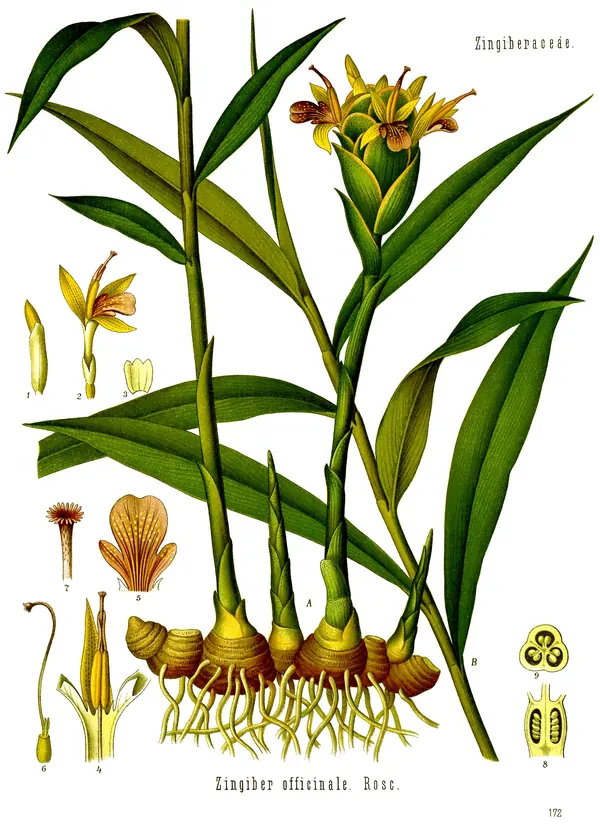
Köhler's Medizinal-Pflanzen (1883–1914), public domain, via Wikimedia Commons
Where to get it
We earn a commission if you buy through these links. It doesn't change your price. How we make money

Traditional & historical use
NCCIH says ginger was traditionally used for conditions such as asthma, flu, indigestion and gastrointestinal discomfort. Ginger has been used in Asian and Ayurvedic medicine for thousands of years as a warming digestive tonic and remedy for nausea.
Active compounds & mechanisms
Key compounds: gingerols, shogaols, paradols, zingerone, volatile oils
Gingerols and shogaols are the primary bioactive compounds in ginger. They inhibit prostaglandin and leukotriene synthesis (anti-inflammatory pathways) and act on serotonin receptors in the gut, which may explain the anti-nausea effect. Ginger also accelerates gastric emptying and acts as a carminative, reducing gas and bloating.
Research & evidence
Strong support Some support Weak or no supportColours show how well the sources back each point. The reason is next to each one.
NCCIH says research shows that ginger may be helpful for nausea and vomiting associated with pregnancy. MSK says ginger may help relieve or prevent nausea and vomiting.
Limited evidenceSome support. The source hedges (“may” or “associated with”)
Study details
NCCIH (Research findings): "Research shows that ginger may be helpful for nausea and vomiting associated with pregnancy." | MSK (Research findings): "Ginger may help relieve or prevent nausea and vomiting."
Source: NCCIH, Ginger (Last Updated February 2025), Research findings View source
NCCIH says most studies of ginger for motion sickness haven't shown it to be helpful. MSK says some studies support the short-term use of ginger for chemotherapy-associated nausea and vomiting and motion sickness.
Mixed evidenceSome support. Results are mixed
Study details
NCCIH (Research findings): "Most studies of ginger for motion sickness haven’t shown it to be helpful." | MSK (Research findings): "Some studies support the short-term use of ginger for chemotherapy-associated nausea and vomiting and motion sickness."
Source: NCCIH, Ginger (Last Updated February 2025), Research findings View source
NCCIH says it's uncertain whether ginger is a helpful addition to standard treatments for nausea and vomiting associated with cancer. MSK says larger studies are needed to confirm potential benefits of ginger supplementation for symptom control or for chemoprevention.
Limited evidenceSome support. Reviewers rated the certainty low
Study details
NCCIH (Research findings): "It’s uncertain whether ginger is a helpful addition to standard treatments for nausea and vomiting associated with cancer…" | MSK (Research findings): "Larger studies are needed to confirm potential benefits of ginger supplementation for symptom control or for chemoprevention."
Source: NCCIH, Ginger (Last Updated February 2025), Research findings View source
NCCIH says research suggests that ginger dietary supplements might be helpful for reducing the severity of menstrual cramps.
Limited evidenceSome support. The source hedges (“may” or “associated with”)
Study details
NCCIH (Research findings): "Research suggests that ginger dietary supplements might be helpful for reducing the severity of menstrual cramps."
Source: NCCIH, Ginger (Last Updated February 2025), Research findings View source
NCCIH says ginger dietary supplements might be helpful for symptoms of knee osteoarthritis. Ginger used topically (applied to the skin) has not been shown to be helpful for knee osteoarthritis symptoms.
Limited evidenceSome support. The source hedges (“may” or “associated with”)
Study details
NCCIH (Research findings): "Ginger dietary supplements might be helpful for symptoms of knee osteoarthritis," | NCCIH (Research findings): "Ginger used topically (applied to the skin) has not been shown to be helpful for knee osteoarthritis symptoms."
Source: NCCIH, Ginger (Last Updated February 2025), Research findings View source
Dosage
| Form | Amount |
|---|---|
| Capsule | 250–1,000 mg per day; studies for nausea typically used 1,000 mg/day in divided doses |
| Tea | 1–2 cups per day; steep 1 tsp grated fresh ginger or ½ tsp dried powder in hot water for 5–10 minutes |
Side effects
Ginger can cause abdominal discomfort, heartburn and diarrhea. Eating fresh ginger in high doses can have blood-thinning effects, and ginger supplements may increase bleeding risk with blood thinners. Talk with your health care provider if you take any medicine.
Well documented Reported (case reports, anecdotal or one study) None reportedThe circle shows how well documented an effect is, not how serious it is. A rarely reported effect can still be serious, so always read ‘When to stop’.
| Effect | Frequency | When to stop |
|---|---|---|
| Abdominal discomfort, heartburn, diarrheaWell documentedListed plainly by NIH, MSK or LiverTox | Not stated | Stop and talk to a doctor if you notice any unexpected or concerning symptoms. |
| Blood-thinning effects (reported with fresh ginger eaten in high doses)Well documentedListed plainly by NIH, MSK or LiverTox | Not stated | Stop and talk to a doctor if you notice any unexpected or concerning symptoms. |
Safety & interactions
Safety
NCCIH says ginger has been used safely in many research studies where it was taken orally (by mouth) as a dietary supplement. Ginger can have side effects such as abdominal discomfort, heartburn and diarrhea. MSK says eating fresh ginger in high doses can have blood-thinning effects by preventing platelets from sticking together. If you take any type of medicine, talk with your health care provider before using ginger or any other herbal products.
Contraindications
MSK says ginger supplements should be avoided in patients with bleeding disorders and by individuals with gallstones, and should not be used around the time of surgery because of blood-thinning effects. On pregnancy, the two sources differ. NCCIH says the use of ginger dietary supplements during pregnancy may be safe, and that if you're considering ginger while pregnant you should consult your health care provider. MSK says ginger supplements should be avoided during pregnancy or lactation, and that ginger is not suggested for use during pregnancy because of risks to the developing embryo. NCCIH says little is known about whether it's safe to use ginger while breastfeeding. If you take blood thinners, insulin or other glucose-lowering drugs, tacrolimus or cyclosporine, see Drug interactions.
Drug interactions
MSK says ginger supplements may increase the risk of bleeding if you are taking warfarin or other blood thinners.
MSK says ginger may increase bleeding risk when it is used together with drugs such as diclofenac or ibuprofen.
MSK says ginger may cause additive reductions in blood glucose. MSK lists this under insulin and hypoglycemic drugs.
MSK says ginger supplements increase the blood levels of tacrolimus and may increase its side effects.
MSK says concomitant ginger use resulted in decreased blood concentrations of cyclosporine in vivo (in a living body).
Established: stated plainly by an authoritative source. Documented: supported by case reports or trial data. Theoretical: based on mechanism, animal data, or a cautious listing. Always check with your pharmacist or prescriber.
Related
Was this page useful? Rate it · Report a mistake